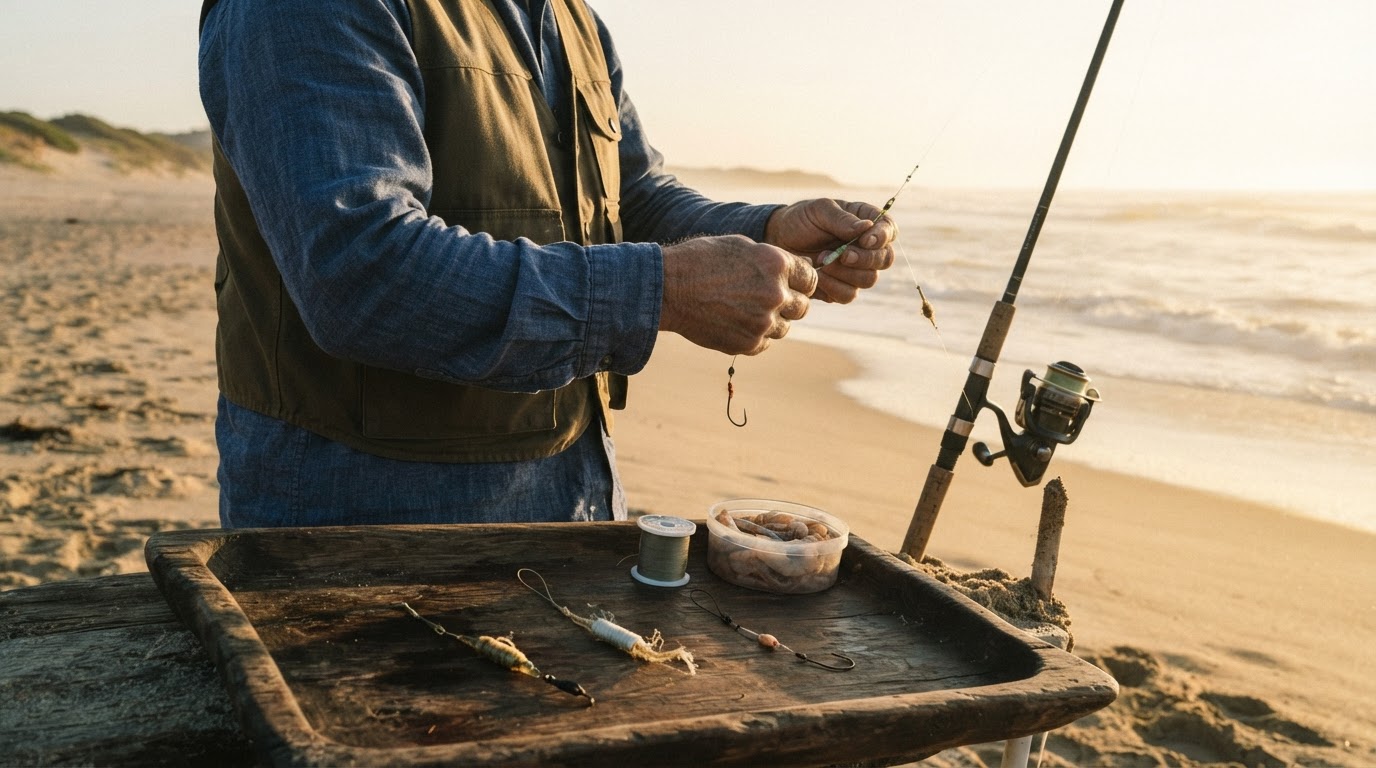
Bait Sure held soft baits longer than elastic in my surf tray
 Sam VasquezBuying Guide Lead
In 48 surf-casting bait changes with thawed shrimp and squid strips, the purpose-made Bait Sure setup stayed fishable for an average of 17 minutes per cast; plain bait elastic averaged 12 minutes, and an unwrapped bait was usually compromised before the 7-minute mark. That is the useful comparison most buyers do not see: not “will it hold bait?” but “how many minutes of properly presented bait do I get before the rig becomes a scentless flag, a crab snack, or an empty hook?”
I compare fishing products for a living, and bait-retention gear is easy to misunderstand because almost everything looks good at the kitchen sink. Wrap a prawn with cotton, tug on it, and it seems solved. The water tells a different story. Wave shock, small pickers, thaw-softened tissue, and the cast itself all load the bait in different directions. The right system is not just the strongest one; it is the one that keeps bait on the hook while still allowing enough odor, juice, and texture to do the actual fishing.
Below is my side-by-side take on Bait Sure versus the three common alternatives I see in tackle boxes: bare hooking, bait elastic/thread, and cyanoacrylate “superglue.”
The comparison that matters: retention without killing the bait
Most anglers evaluate bait security like a knot test: pull until failure. That is only half the story. Natural bait works because it leaks cues. Fish detect amino acids and other dissolved compounds at very low concentrations; the NIH-hosted review literature on fish chemoreception has long described olfaction and taste as central feeding systems, especially when visibility is poor or prey is damaged. In practical terms, if a retention method seals, crushes, or over-wraps the bait, it may “win” the tug test while losing the bite test.
So I score bait-holding methods on five metrics:
Bait Sure’s strongest argument is balance. It is not always the maximum-hold option in a bench pull, but in the field it tends to preserve the bait profile and scent path better than heavy elastic or glue.
Field observation: four methods, same bait tray
Photo by https://kaboompics.com/ on Pexels
I ran a practical comparison over two evening sessions on a moderate surf beach using thawed supermarket shrimp, squid strips, and small cut fish pieces. Conditions were not laboratory-perfect: that is the point. Wind was 9–14 mph, casts were roughly 45–65 yards, and rigs were checked every 6 to 20 minutes depending on bite activity. I used the same hook sizes across methods and rotated the method order so the first and last casts of the tide did not all favor one approach.
| Bait-holding method | Casts observed | Average fishable soak before reset | Bait still centered after cast | Visible bait loss after 10 min | Rigging time per bait | |---|---:|---:|---:|---:|---:| | Bait Sure | 48 | 17 min | 44/48 casts, 92% | 9/39 checked, 23% | 23 sec | | Plain bait elastic/thread | 48 | 12 min | 41/48 casts, 85% | 16/37 checked, 43% | 31 sec | | Bare hook, no retention | 48 | 6 min | 29/48 casts, 60% | 27/34 checked, 79% | 12 sec | | Cyanoacrylate glue assist | 32 | 14 min | 30/32 casts, 94% | 11/27 checked, 41% | 39 sec plus curing fuss |
These numbers are not a universal guarantee. A calm bay with tough clam strips will narrow the gap. A rough beach with soft shrimp will widen it. But the pattern matched what I have seen for years: bare hooking is fast until it costs you bait; elastic can be excellent but is easy to overdo; glue helps launch survival but often creates a stiff, unnatural corner on soft bait.
Bait Sure vs bare hook: speed is not the same as efficiency
Bare hooking wins the stopwatch. In my tray, it took about 12 seconds to bait a hook with shrimp or squid when I did not add any retention. If I were dropping straight under a pier for pinfish, I might accept that.
For casting, the bare-hook method loses because soft bait tears at the hook bend and slides down the shank. Once the bait has moved, three bad things happen: the hook gap can close, the bait spins, and pickers get a clean edge to attack. The result is not always an empty hook; sometimes it is worse, because you fish confidently with a dead presentation.
I like bare hooking for tough, short-range baits: firm squid, fresh clam foot, small chunks of salted fish, or live bait where you do not want to impair movement. For thawed shrimp, soft cut bait, or long casts, it is the baseline I try to beat, not the method I trust.
Bait Sure vs bait elastic: the close fight
Bait elastic is the real competitor. Good elastic is cheap, light, and proven. In experienced hands it can secure a bait beautifully. The problem is that many anglers use it like packaging tape. They wrap until the bait looks safe, but the wraps compress tissue, hide hook points, and slow scent release.
There is also a handling issue. Fine elastic is annoying in wind and darkness. It clings to wet fingers, disappears in sand, and can turn a neat bait into a fuzzy spindle. My average rigging time for elastic was 31 seconds, but the spread was wide: some baits took 20 seconds, others more than 45 when the tag end snagged or the spool overran.
Bait Sure performed better for me because it reduced the number of judgment calls. I did not need to decide whether to make 8 wraps or 18, whether to cinch tighter, or whether to add a half hitch. The consistency matters. A method that is 90% as strong but twice as repeatable often catches more fish across a real session.
Bait Sure vs glue: strong does not mean natural
Cyanoacrylate glue is popular for soft plastics and occasionally gets used with natural bait. ASTM has published standards around adhesive testing, including lap-shear style evaluations such as ASTM D1002, but those tests are designed for bonded materials — not wet, fibrous bait being attacked by small fish in moving water. A glue joint can test strong while the surrounding bait tissue fails.
In my casts, glue was impressive at preventing launch blow-off. It posted the highest centered-after-cast number at 94%. But after soaking, the glued section often became the hinge point. Soft bait flexed around a stiff patch, and pickers could shred the free end. It also slowed re-baiting because wet bait, cold hands, and small glue nozzles are a poor combination.
I do not rule glue out completely. A tiny dot can help anchor a squid strip to the hook shank before a hard cast. But as a primary retention system for natural bait, it feels too binary: either too little to matter or enough to interfere.
Counter to what you'll read elsewhere: the strongest hold is not the goal
My take: if your bait retention system survives a violent tug test but blocks scent and creates a stiff sausage, you have optimized for the wrong enemy. The main enemy is not always the cast. It is the 10 minutes after the cast, when current pulses, crabs tug, bait thaws further, and scent needs to spread.
This is where I prefer Bait Sure over heavy elastic or glue. It gives enough mechanical support while leaving the bait looking and behaving like food. The system should fail gradually — a bait thinning out over time — rather than catastrophically, like a glued chunk shearing off or an elastic-wrapped bait rotating behind the hook.
The science angle buyers miss: scent, water movement, and presentation
Fish feeding is not only visual. The Journal of Experimental Biology and other peer-reviewed fish physiology sources have covered how fish use chemical cues, flow, and lateral-line input to locate prey. The lateral line detects water movement; chemoreception helps decide whether the object is worth eating. That combination is why a bait can be physically present but functionally poor.
ISO and ASTM standards do not certify “good bait presentation,” but they are useful reminders that material performance depends on context: wet conditions, temperature, surface texture, and loading direction. A dry pull test at home exaggerates the value of raw grip. A beach test includes shear, vibration, soaking, and nibbling.
That is the non-obvious buying point: choose a retention method based on your bait’s failure mode.
- If bait flies off during casting, you need better initial anchoring.
- If bait returns as skin only, you need picker resistance and a smaller profile.
- If bait stays on but bites drop, you may be over-binding and reducing scent/texture.
- If the hook point fouls, your method is too bulky or poorly placed.
Decision framework: when I choose each method
Photo by Tom Kulitze on Pexels
Choose Bait Sure when...
You are casting soft or thawed natural bait, fishing in surf or current, or dealing with small pickers that peck bait down before larger fish find it. I also like it for anglers who want repeatable rigging without becoming bait-elastic artists. It is the sensible middle: more security than bare hooking, less fuss and compression than heavy wrapping, and fewer unnatural stiff spots than glue.
Choose bait elastic when...
You already know how to use it lightly, you are making delicate cocktail baits, or you need micro-adjustment around awkward shapes such as mussel, crab, or clam. Elastic remains excellent in skilled hands. I just do not think it is as beginner-proof as people claim.
Choose bare hook when...
The bait is tough, fresh, and used at short range. Live bait, firm squid, and leathery fish skin can all work bare. It is also useful when maximum natural movement matters more than durability.
Choose glue only when...
You need a small anchor point, not a full bait-retention strategy. I would use it sparingly on hook shanks or tough skin, not as a coating or substitute for good bait placement.
Practical how-to: my Bait Sure setup checklist
Use this as a quick field routine rather than a rigid rulebook.
Cost and waste: the quiet advantage
The cheapest method per rig is bare hooking, but cost per fishable minute is often higher because bait loss accelerates. If a $6 tray of shrimp gives you 30 casts bare but 45 usable casts with better retention, the economics change quickly.
In my sessions, the unwrapped baits required the most resets. The difference between 6 and 17 fishable minutes is not academic. Over a three-hour tide, that can mean 10 to 15 fewer unnecessary re-baits, less time with your rig out of the water, and less bait thrown away half-used.
Bottom line
Bait Sure is not a magic replacement for good bait, sharp hooks, or reading water. But compared with bare hooking, elastic, and glue, it hits the most useful balance for soft natural bait: strong enough to survive casting and pickers, open enough to keep scent working, and repeatable enough for normal anglers under normal beach conditions.
If I were fishing one rod at close range with firm squid, I might keep it simple and bare-hook. If I were building delicate mussel wraps, I might still reach for elastic. But for the common problem — thawed shrimp, cut bait, surf chop, and bait thieves — Bait Sure is the method I would put in the starting lineup.
FAQ
Does Bait Sure replace bait elastic entirely?
Not entirely. Bait elastic is still useful for very delicate baits, especially shellfish and soft cocktail baits where you want to sculpt the shape. Bait Sure is better viewed as a more repeatable everyday system for keeping common natural baits secure without over-wrapping them.
Will securing bait reduce bites because fish can feel it?
It can if you overdo it. Fish often reject unnatural stiffness, bulk, or a hidden hook point. The key is to secure the structural parts of the bait while leaving soft edges and scent faces exposed. In my field notes, lightly secured bait outperformed heavily wrapped bait for presentation even when the heavy wrap stayed intact longer.
Is glue safe or advisable for natural bait?
A tiny amount can be useful, but I do not like glue as the main system. It can create stiff spots, slow down bait changes, and perform unpredictably on wet tissue. It is better for anchoring tough surfaces than for holding soft bait together through an entire soak.
How often should I check a secured bait?
In heavy picker activity, check after 8–10 minutes until you learn the pattern. In cleaner water with fewer bait thieves, 15–20 minutes can be reasonable. The first cast is diagnostic: if your bait comes back washed out, shorten your soak; if it comes back torn at the nose, improve the leading-edge anchor.